
Boolean search is an information search method that uses logical operators (such as AND, OR, and NOT) to combine or exclude specific keywords. The aim is to obtain search results that are more accurate and relevant than regular searches. George Boole, a British mathematician, first introduced this method.
Why Boolean Search?
Amidst the abundance of information in the digital age, we often find it difficult to find truly relevant data and, without realizing it, waste time scrolling. This is where this method plays an important role. With Boolean Search, we can minimize irrelevant search results and reduce wasted time. In addition, this method is also often used in academic research, such as using Boolean operators in Google Scholar to filter research related to specific topics.
Boolean Search Operators
In Boolean Search, there are three (3) basic operators that are often used to filter search results effectively.
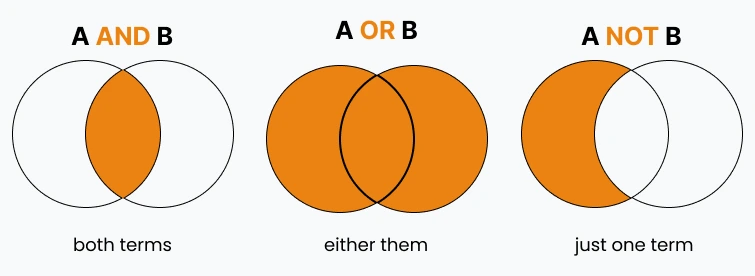
The following are the 3 basic operators used in Boolean searches:
1. AND
The AND operator is used to search for all terms in the search results. For example, health AND ‘climate change.’ The search engine will only provide results that discuss both.
2. OR
The OR operator allows us to connect one or two or more terms and expand the search results. For example, ‘global warming’ OR ‘climate change.’ The search engine will display results related to either of these two terms.
3. NOT
The NOT operator is used to exclude or remove certain words from the search results. For example, technology AND education, NOT ‘educational games.’ The search engine will exclude or remove the words ‘educational games’ and only display results related to ‘technology AND education.’
In addition to the three basic operators above, here are some operators that are commonly used in Boolean search:
4. Quotation Marks (‘ ’)
Quotation marks are used to search for exact phrases—for example, a ‘machine learning’ tutorial. The search engine will return results that contain that phrase.
5. Parentheses ( )
Parentheses are used to keep complex queries neat—for example, (‘renewable energy’ OR ‘green energy’) AND policy. The search engine will prioritize the logical operations inside the parentheses first. From the example above, it will produce searches related to ‘renewable energy policy’ or ‘green energy policy.’
6. Wildcard *
Using this symbol allows the search engine to expand the scope of the search when we want to find all variations of a basic concept. For example: educat* → education, educational, educator, etc. The search engine will provide results that include variations of the words in the example, such as ‘education,’ “educational,” and ‘educator.’
Three Minor but Fatal Mistakes in Boolean Search
There are three minor mistakes that often occur but can ruin our overall search results:
- Forgetting to Use Quotation Marks (‘ ’) for Important Phrases: This causes the search engine to break up our phrase, causing us to lose precision and get irrelevant results.
- Long Queries Without Parentheses ( ): Without clear grouping, the search engine misinterprets the AND/OR/NOT logical priorities, resulting in messy and off-target results.
- Overly General Keywords: Less specific keywords will generate a sea of unfocused results (noise), making it difficult for us to find the core information (signal) we are looking for.
Conclusion
‘Boolean search is one of the fastest ways to obtain more relevant search results compared to regular searches.’