
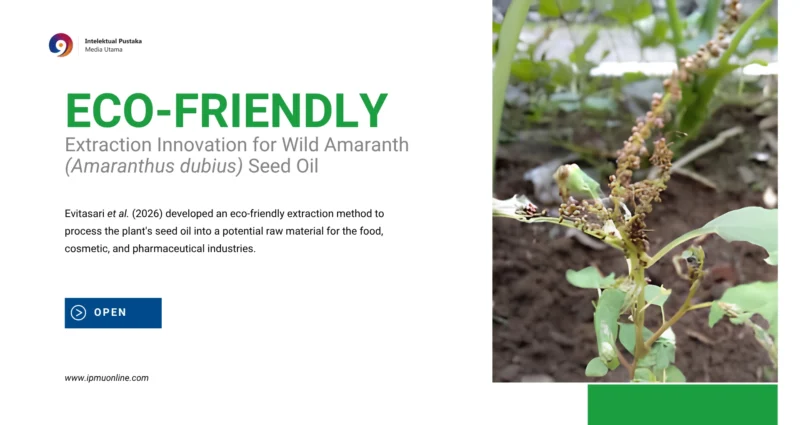
A recently published study reveals the significant potential of wild amaranth (Amaranthus dubius) as a source of high-value vegetable oil. This resource has remained underutilized despite the plant’s abundance in Indonesia. Evitasari et al. (2026) developed an eco-friendly extraction method to process the plant’s seed oil into a potential raw material for the food, cosmetic, and pharmaceutical industries.
Abstract
This research will explore the potential for utilizing wild amaranth (Amaranthus dubius) seeds, which are abundant and have not been utilized in Indonesia. This research will focus on optimizing the amaranth seed oil extraction process using the response surface method and the characteristics of the oil produced from amaranth seeds. The solvent used in this research is a biobased green solvent, terpenes. This research aims to explore the potential of utilizing wild amaranth seeds by optimizing the oil extraction process using a biobased green solvent, terpenes, through the response surface methodology (RSM). Fourier transform infrared spectroscopy (FTIR) results indicate that the terpenes solvent contains various terpenoids such as α-pinene, β-pinene, and camphene. By applying ultrasound-assisted extraction (UAE) and optimizing the critical process parameters (liquid-to-solid ratio, extraction temperature, and extraction time) through a Box-Behnken RSM design, the maximum oil yield was achieved under environmentally friendly conditions. The optimum condition was reached at a solvent-to-solid ratio of 5.13 ml/0.1 g, a temperature of 49.39 °C, and an extraction time of 47 minutes. With these optimal parameters, the predicted oil yield was 2.04%. The optimized extraction not only delivered a high-quality oil-rich extract but also minimized solvent residue, energy consumption, and hazardous emissions.
– Evitasari et al. (2026) –
High-Value Composition
Wild amaranth seed oil possesses a rich profile of essential fatty acids, including:
- Linoleic acid: 36.7%
- Palmitic acid: 19.1%
- Oleic acid: 18.7%
- Squalene: 3.6%–6.1%
The squalene content in wild amaranth seeds is much higher than in conventional vegetable oils, such as olive oil (0.4%), rice bran oil (0.3%), and coconut oil (0.002%). This positions wild amaranth as a promising natural source for antioxidant benefits and skin protection in cosmetic, nutraceutical, and pharmaceutical applications.
A Safer Extraction Method
To replace conventional solvents like n-hexane, which pose environmental risks, the research team employed Ultrasound-Assisted Extraction (UAE) using a terpenes-based “green solvent” derived from pine trees. FTIR analysis revealed that this solvent contains active compounds such as α-pinene, β-pinene, and camphene; it offers solubility comparable to n-hexane but features a higher flash point, making it safer to use.
This research confirms that a green solvent-based extraction approach can produce high-quality oil while minimizing solvent residues, energy consumption, and harmful emissions, aligning with the principles of sustainable chemical engineering. These findings open up opportunities to utilize wild spinach as a greener alternative raw material for the food and cosmetics industries.
Reference
R. T. Evitasari et al., “Amaranthus dubius seeds oil extraction using green solvent approach with terpenes,” International Journal of Advances in Applied Sciences, vol. 15, no. 3, p. 964, Sep. 2026, doi: 10.11591/ijaas.v15.i3.pp964-974. Available: https://ijaas.iaescore.com/index.php/IJAAS/article/view/22279